Dust collector filter bag


Car Air Filter Production Process

Truck Air Filter Production Process

Cabin Air Filter Production Process

Spin-On Fuel & Oil Filter Production Process

Eco-Friendly Fuel & Oil Filter Production Process

Toyota Car Oil Filter Production Process

Toyota Car Fuel Filter Production Process

Hydraulic Filter Production Process

Dust Collector Filter Bag Production Process

Dust Collector Filter Cartridge Production Process

Primary, Medium & High-Efficiency Filters Production Process

What is filter fabric? Filter fabric is a filtering medium woven from natural or synthetic fibers. The materials of filter fabric include natural fibers such as cotton, hemp, wool, silk, etc.; Synthetic fibers include polypropylene, polyester, nylon, vinylon, etc., among which polyester and polypropylene are the most commonly used. In a broader sense, filter fabric materials also include various inorganic fibers, such as glass fiber, metal fibers, asbestos fibers, etc. Here, our products mainly focus on synthetic fibers. Filter fabric is widely used in industries such as pharmaceuticals, chemicals, dyes, steel, construction, iron smelting, ceramics, cement, geology, and mining. It is used for filtering air, dust, liquids, etc. Filter fabric is divided into two types based on manufacturing methods: woven filter fabric and non-woven filter fabric.
Filter Fabric Types
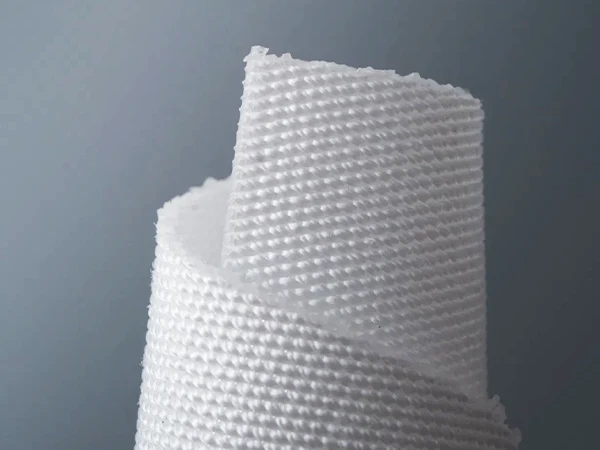
Woven Filter Fabric
Woven filter fabric is made by interlacing woven fibers in a certain pattern. Woven filter fabric is primarily produced using a loom through steps such as spinning, sizing, warping, threading, weaving, setting, and calendering. The main types are plain weave, twill weave, and satin weave. Plain weave fabric has many interlacing points and poor breathability; Satin weave fabrics have the fewest interlacing points, good breathability, a smooth surface, and are relatively easy to clean. Twill weave fabrics have a smooth surface, are relatively easy to clean, and have high strength, combining the advantages of strength and good dust collection.
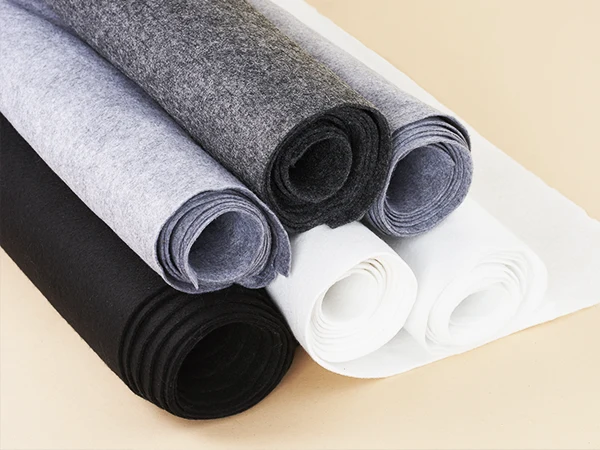
Non-Woven Filter Fabric
Non-woven filter fabric is commonly referred to as non-woven fabric. It does not go through the usual spinning and weaving processes but directly forms a web of fibers. It is called fabric because it has the appearance and some properties of cloth. The production processes and procedures include: dry-laid web formation (needle punching, hydroentanglement, stitch bonding, thermal bonding, chemical bonding); spunbond method; melt blown process; electrospinning; wet-laid web formation, etc. Non-woven fabric breaks through the traditional textile principles and features a short process flow, fast production speed, high output, low cost, wide application, and diverse sources of raw materials.
Non-Woven Fabric Filtration Mechanism
Most of the theories related to non-woven fabrics are based on the in-depth filtration effect. It is much more complex than simple screening or sieving. For particle capture, in-depth filtration and separation theories are more relevant than other mechanisms. At this time, inertial effect, interception effect, diffusion effect, electrostatic effect, and gravitational effect occur, thereby capturing dust particles.

Non-Woven Fabric Category
According to their use, they can be divided into exhaust non-woven fabric and intake non-woven fabric.
Exhaust Non-Woven Fabric
Exhaust non-woven fabric. Common materials include ordinary fiber types such as polyester fiber, polyamide fiber, polyolefin fiber, polyvinyl chloride fiber, polyacrylonitrile fiber, conductive fiber, and high-performance fiber types such as polytetrafluoroethylene fiber, polyphenylene sulfide fiber, Teflon fiber, Nomex fiber, and polyimide fiber. The main production processes are needle punching and hydroentanglement. Surface treatment methods include heat setting, singeing, calendering, impregnation, coating, and other treatments. Mainly used in dust filter bags and dust filter cartridges.
Dust collector filter bag
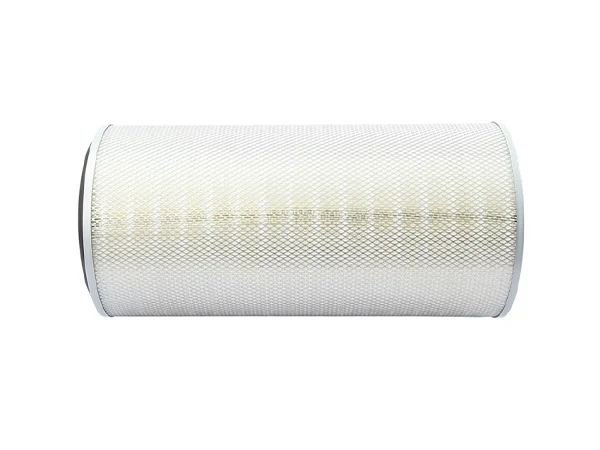
Dust collector filter cartridge
Common Types of Exhaust Non-Woven Fabric
| Category | Type | Characteristics | Remarks | |
|---|---|---|---|---|
| Medium and normal temperature exhaust non-woven fabric | Polyester needle-punched felt | Good air permeability, high dust collection rate, wear-resistant, long service life; poor hydrolysis resistance | It is one of the most widely used varieties among felts | |
| Polypropylene needle-punched felt | Low temperature resistance, excellent economic; poor resistant to high temperatures | – | ||
| Acrylic needle-punched felt | Good hydrolysis resistance, acid and alkali resistance; poor high temperature resistance | – | ||
| Microfiber needle-punched felt | High filtration efficiency, low pressure drop, high mechanical performance | Raw material ratio: 30% polyester superfine staple fiber + 70% ordinary polyester staple fiber + polyester filament base fabric | ||
| Antistatic exhaust non-woven fabric | Excellent conductivity and anti-static | Add conductive fibers to the raw materials or use conductive base fabric to make anti-static needle felt | ||
| Water and oil repellent exhaust non-woven fabric | Water resistance, oil resistance, high temperature resistance, durability | Fluorides are usually used as water and oil repellents for non-woven fabrics | ||
| Membrane-coated exhaust non-woven fabric | High surface filtration efficiency, low pressure and high flux continuous operation, easy to clean, long lifespan | Membrane-coated non-woven fabric is made by laminating a microporous membrane, made from dispersed polytetrafluoroethylene resin, with various base fabrics. | ||
| High-temperature exhaust non-woven fabric | Aramid needle felt | High temperature resistance, flame retardant, high strength, corrosion resistance | – | |
| Nomex | Excellent dust filtration performance | – | ||
| PPS exhaust non-woven fabric | Good thermal stability, excellent acid resistance, excellent hydrolysis resistance, flame retardant, chemical resistance; poor oxygen resistance | – | ||
| P84 high-temperature needle felt | High temperature resistance, chemical resistance; slightly poor acid resistance | – | ||
| PTFE exhaust non-woven fabric | High temperature resistance, high humidity resistance, strong chemical corrosion resistance | – | ||
| FMS high-temperature exhaust non-woven fabric | Wear-resistant, good flexural resistance, thorough dust removal. There are many types, including high-temperature resistant, corrosion-resistant, high wear-resistant, and high-efficiency types. | It is a fiber-based composite filter material, a fiber-based non-woven fabric made by blending and processing two or more different fibers, such as glass fiber and synthetic fibers, into a needle-punched felt. | ||
| HBT high-temperature resistant composite needle-punched felt | Divided into three categories: medium temperature type, high temperature type, and strong special type | It is a special non-woven fabric used for boiler flue gas purification treatment. It is made by blending several types of organic high-strength specialty fibers in different proportions with inorganic glass fibers, needle-punching them into felt, and then post-processing with PTFE solvent. It is an improved version of FMS. | ||
| High-temperature gradient composite exhaust non-woven fabric | High filtration efficiency, low resistance, easy to clean, corrosion-resistant, high-temperature resistant, and hydrolysis resistant. Suitable post-treatment can be performed according to requirements. | Mainly used for flue gas filtration in high-temperature furnaces and kilns. It is composed of fibers such as PPS, P84, PTFE, and glass fiber through different optimized combinations. | ||
Intake Non-Woven Fabric

Common materials for intake non-woven fabric include polypropylene fiber, polyacrylonitrile fiber, polyester fiber, polyvinyl alcohol fiber, polyvinyl chloride fiber, polytetrafluoroethylene fiber, bicomponent fibers, and multicomponent fibers. The production process and treatment of intake non-woven fabric are more complex and detailed compared to exhaust non-woven fabric. It not only includes various binders, additives, and fibers as raw materials but also involves many web-forming technologies and process flows. Its application range is wide, including primary, medium, and high-efficiency filters, automotive air filters, cabin air filters, household air purifiers, and other fields.
Intake Non-Woven Fabric Classification
| Chinese standards GB/T14295 |
For General Ventilation | For Clean Rooms | |||||||||||||||
|---|---|---|---|---|---|---|---|---|---|---|---|---|---|---|---|---|---|
| Coarse Efficiency | Medium Efficiency | High-Medium Efficiency | Sub-High Efficiency | High efficiency | Ultra-High Efficiency | ||||||||||||
| United States ASHRAE standards | C1 | C2/C3/C4 | L5/L6 | L7/L8 | M9/M10 | M11/M12 | M13 | M14 | H15 | H16 | UH17/UH18 | UH19 | UH20 | ||||
| New European Standards | G1 | G2 | G3 | G4 | F5 | F6 | F7 | F8 | F9 | H10 | H11 | H12 | H13 | H14 | U15 | U16 | U17 |
| Efficiency E (%) | 65 | 80 | 90 | 60 | 80 | 90 | 85/95 | 99.5 | 99.5 | 99.995 | 99.9995/99.99995 | ||||||
| Gravimetric method | Colorimetric method | MPPS method (DOP method) | |||||||||||||||